Building FitMyCV: How I Built an AI-Powered CV Tailoring Tool
Farirai Masocha / March 25, 2026
Building FitMyCV: How I Built an AI-Powered CV Tailoring Tool
I've applied to hundreds of jobs. And like most people, I used to send the same CV every time. The result? Silence. No callbacks, no interviews, no feedback. When I learned that 75% of applications are filtered out by ATS software before a recruiter even sees them, I decided to fix the problem myself.
The Idea
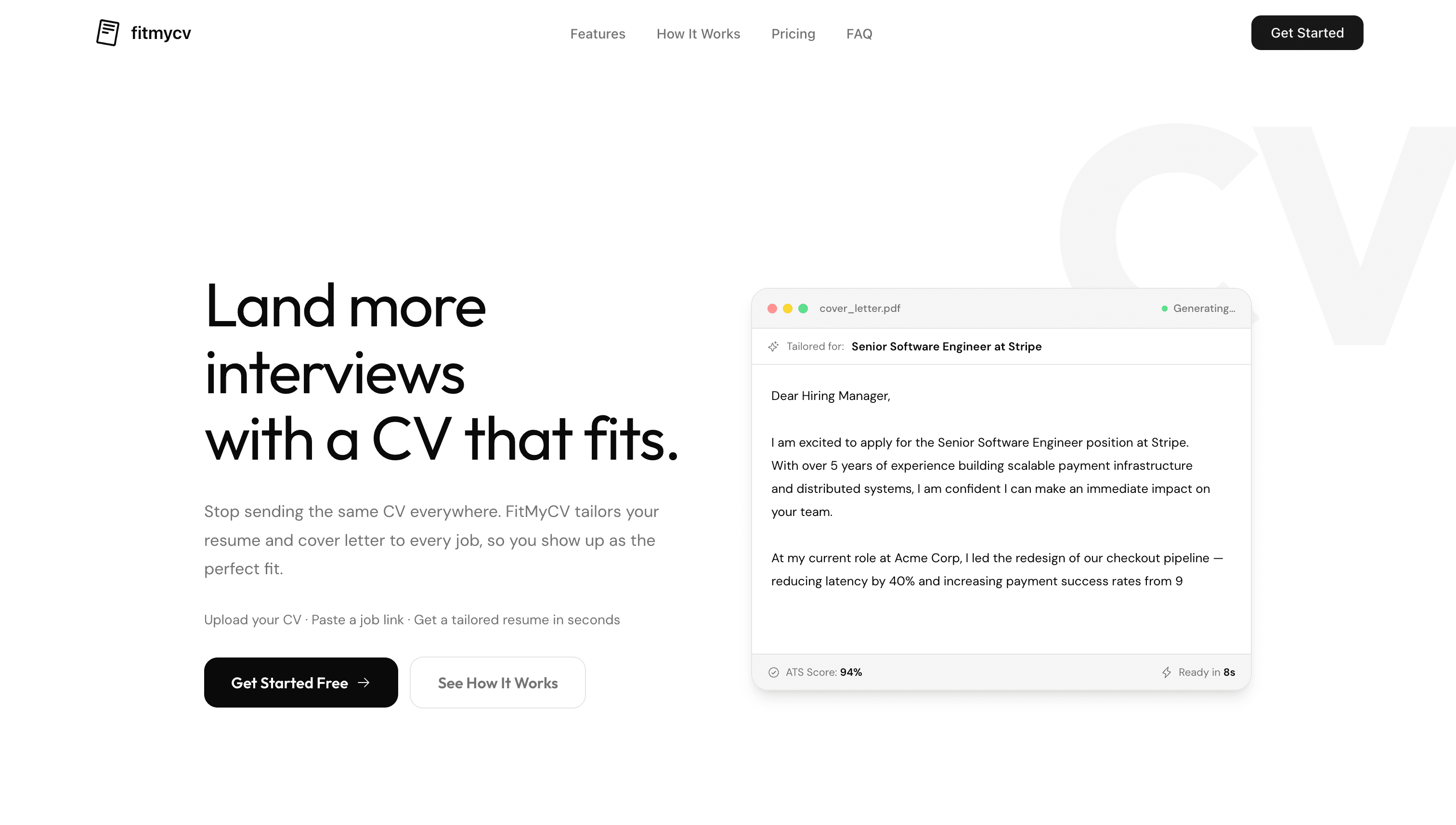
The concept was simple: what if you could paste a job listing URL and get a perfectly tailored CV back in seconds? Not a template. Not a formatting tool. An actual AI rewrite that understands the job requirements and maps your experience to match.
That's FitMyCV.
Why ATS Optimization Matters
Applicant Tracking Systems scan CVs for keyword matches against the job description. If your CV doesn't contain the right terms — even if you have the right experience — it gets filtered out automatically. Recruiters typically spend 6 seconds scanning a CV that makes it through. Every word counts.
FitMyCV solves both sides: it gets you past the ATS filter and makes the human review count by highlighting your most relevant experience for each specific role.
The Technical Build
AI Pipeline
The core pipeline has three stages:
- Job Extraction — When you paste a URL, Groq parses the job page and extracts structured requirements: skills, qualifications, responsibilities, and company context.
- CV Tailoring — OpenAI's GPT-4o-mini takes your reference CV and the extracted requirements, then rewrites bullet points, adjusts language, and optimizes keyword placement while keeping your authentic experience intact.
- Cover Letter Generation — Using the same job context and your tailored CV, the AI generates a personalized cover letter that ties your experience directly to the role.
PDF Parsing
Users upload their base CV as a PDF. I use the unpdf library to extract text client-side, then send it through AI to convert unstructured text into a clean JSON Resume schema. This structured data becomes the foundation for all future tailoring.
Match Scoring
After tailoring, the system calculates an ATS compatibility score (0–100%) by comparing keyword overlap, skills coverage, and structural alignment between your CV and the job requirements. Users can see exactly where they match and where gaps remain.
Template System
I built six PDF templates — Minimal, Executive, Creative, Tech, Classic, and Bold — using jsPDF. Each template is optimized for readability and ATS parsing, with clean formatting that works across different screening systems.
Stack Decisions
- Next.js 16 + React 19 for the framework — server components for the dashboard, client components for the interactive tailoring flow.
- MongoDB for storing reference CVs, tailored outputs, and company research.
- Groq over Anthropic for the initial job parsing — faster response times at lower cost for the extraction step.
- OpenAI GPT-4o-mini for the actual tailoring — the right balance of quality and speed for rewriting CV content.
- Zustand for client-side state management during the multi-step tailoring flow.
- TanStack React Query for data fetching with optimistic updates on the dashboard.
The Company Research Feature
One feature I didn't plan but users love: when you paste a job URL, FitMyCV automatically generates a company research brief. It pulls together company info, funding stage, team size, and role-specific insights — essentially giving you interview prep material alongside your tailored CV.
What I Learned
Building FitMyCV taught me that the best AI products don't try to replace the user — they amplify what's already there. FitMyCV doesn't invent experience. It takes what you've actually done and presents it in the language each specific job is looking for.
The difference between a generic CV and a tailored one isn't the content — it's the framing. And that's exactly what AI is good at.
Try it yourself at fitmycv.co.